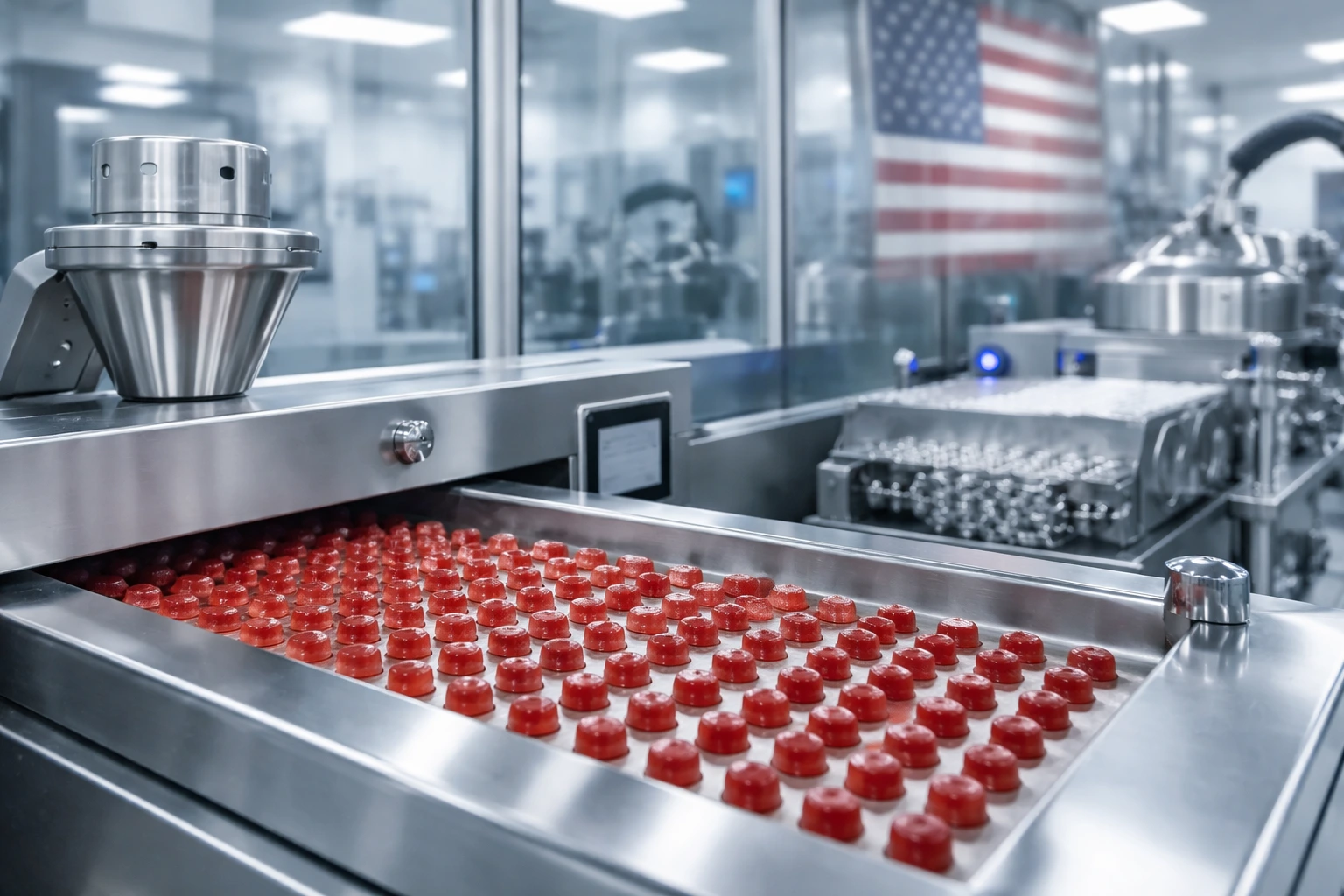
The supplement industry has had a rough couple of years when it comes to supply chain stability. Between shifting tariff structures, overseas shipping delays, and growing concerns about quality oversight gaps, distributors and brand owners are rethinking where their products get made. For gummy vitamins specifically, where manufacturing is already more technically demanding than capsules or tablets, those risks compound fast.
If you’re evaluating gummy vitamin manufacturers or considering a switch from an overseas supplier, the “where” of manufacturing deserves more scrutiny than it typically gets. Here’s why domestic production has become a strategic advantage, not just a preference.
Tariff Volatility Hits Harder Than You Think
The tariff environment for supplement ingredients and finished goods has been anything but stable. Section 301 duties on Chinese imports, reciprocal tariffs, and the back-and-forth around IEEPA authorities have created a pricing environment that’s difficult to plan around. Depending on the category and origin, combined duty rates on Chinese-sourced supplement inputs have ranged anywhere from 10% to well over 40% in recent years.
For distributors, that unpredictability flows directly into cost of goods. When your manufacturer sources ingredients, packaging materials, or finished products from overseas, every tariff adjustment becomes a margin conversation. Some of those adjustments happen with weeks of notice. Others happen overnight.
U.S.-based gummy vitamin manufacturers that source domestically or maintain stateside inventory reduce that exposure significantly. It doesn’t eliminate every variable (some raw ingredients still originate overseas regardless of where manufacturing happens), but it removes multiple layers of tariff risk from the equation. For brands trying to hold pricing or maintain margins, that stability matters.
Supply Chain Reliability Is a Competitive Advantage
Overseas manufacturing introduces lead time variables that are hard to control. Ocean freight schedules shift. Port congestion creates bottlenecks. Customs holds add days or weeks that nobody planned for. And when something goes wrong mid-production, you’re managing it across a 12-hour time difference.
Domestic manufacturing compresses the supply chain in ways that show up in day-to-day operations. Shorter shipping distances mean faster turnaround on orders. Ground freight is more predictable than international logistics. And when issues arise during production (ingredient substitutions, packaging delays, batch adjustments), they can be addressed in real time rather than through a chain of emails that spans multiple business days.
For brands that are scaling or running lean inventory, those time savings aren’t minor. They’re the difference between staying in stock and explaining backorders to retail partners.
Regulatory Alignment and Quality Oversight
The FDA requires all dietary supplement manufacturers, domestic and foreign, to comply with current Good Manufacturing Practices (cGMP) under 21 CFR Part 111. On paper, the requirements are the same regardless of where a facility is located. In practice, enforcement looks very different.
The FDA inspects roughly 500 to 600 dietary supplement facilities per year. The majority of those inspections happen domestically. Foreign facilities get inspected far less frequently, and when they do, the violation rate is notably higher. In FY23, 60% of foreign facilities that were inspected received a Form 483 (a notice of observed violations), compared to a lower rate among domestic operations.
That gap matters because gummy vitamins are particularly sensitive to manufacturing conditions. Moisture control, temperature management, ingredient stability, and texture consistency all require tight process controls. A facility that’s rarely inspected and operating under a different regulatory framework presents more risk to your product quality and your brand reputation.
When your manufacturer operates under direct FDA oversight and maintains documented quality systems with in-process testing and finished product verification, you have a clearer picture of what’s happening at every stage of production.
Communication Isn’t a Soft Benefit
It’s easy to dismiss communication and time zone alignment as “nice to have” rather than operationally significant. But anyone who’s managed a product launch or dealt with a mid-run formulation issue through an overseas manufacturer knows better.
When your manufacturer is in the same time zone (or close to it), problems get solved in hours instead of days. Questions about packaging specifications get answered before they become production delays. Formulation adjustments can be discussed and decided in a single call rather than a week of asynchronous back-and-forth.
This becomes especially important during product development, when decisions need to happen quickly and trade-offs need to be understood in real time. A manufacturer that operates as a collaborative partner rather than a distant vendor can meaningfully compress your time to market.
Formulation Security and IP Protection
Gummy formulations represent real intellectual property. The specific combination of active ingredients, flavor systems, texture profiles, and stability solutions that make a product work are often the result of significant development effort.
When manufacturing happens overseas, formulation details pass through more hands, more systems, and more jurisdictions. IP protections vary by country, and enforcement can be limited even where protections technically exist. Knockoff products sourced from the same region (or even the same facility) are a known issue in the supplement space.
Domestic manufacturing with a vertically integrated partner keeps your formulation data within a tighter circle. U.S. legal frameworks for trade secret protection and contractual enforcement are well-established, and the practical reality of working with a single domestic facility reduces the number of touchpoints where proprietary information could leak.
What This Means If You’re Evaluating Manufacturers
None of this is to say that every overseas manufacturer is unreliable or that domestic production automatically guarantees quality. But the structural advantages of U.S.-based manufacturing are real and measurable: lower tariff exposure, shorter lead times, stronger regulatory oversight, faster communication, and better IP protection.
For distributors evaluating gummy vitamin manufacturers, the question isn’t just “can this facility make my product?” It’s whether the manufacturer can deliver consistent quality, predictable timelines, and stable pricing over the long term. Domestic manufacturing makes all three easier to achieve.
Frequently Asked Questions
Does U.S.-based manufacturing cost more than overseas production?
The unit cost for domestically manufactured gummy vitamins can be higher than overseas alternatives on a per-bottle basis. But that comparison often ignores tariff exposure, shipping costs, customs fees, longer lead times, and the cost of quality issues that are harder to catch and resolve at a distance. When you factor in total landed cost and risk, the gap is often smaller than it appears, and sometimes it disappears entirely.
Are all supplement ingredients available from U.S. sources?
Not all of them. Some raw materials, particularly certain vitamins and botanical extracts, are still primarily sourced from China and other countries. A U.S.-based manufacturer doesn’t necessarily eliminate all overseas sourcing, but it does mean the manufacturing, testing, packaging, and quality oversight happen domestically. That’s where the majority of supply chain risk concentrates.
How do tariffs affect gummy vitamin pricing for distributors?
Tariff rates on supplement-related imports have fluctuated significantly over the past two years, with combined duties on some Chinese-origin inputs exceeding 40%. These costs typically get passed through to distributors, either directly or through adjusted pricing from the manufacturer. Working with a domestic manufacturer that minimizes import dependency helps insulate your pricing from these swings.
What should I ask a manufacturer about their quality systems?
Ask specifically about cGMP compliance documentation, in-process testing protocols, finished product verification, and how they handle out-of-spec results. A manufacturer that can walk you through their quality assurance process in detail is a better bet than one that offers vague assurances about meeting industry standards.
Can I visit a U.S.-based manufacturing facility before committing?
Most reputable domestic manufacturers welcome facility tours or audits from prospective clients. This is one of the practical advantages of working with a U.S.-based partner. You can see the operation firsthand, meet the team, and verify that the facility matches what’s been represented. That level of transparency is significantly harder to achieve with overseas manufacturers.
Is white label or custom formulation better for brands new to gummy vitamins?
White label gummy manufacturing is typically the faster and lower-risk path for brands entering the gummy vitamin space. Pre-formulated products have already been tested for stability, taste, and manufacturability, so you can get to market faster with lower upfront investment. Custom formulation makes more sense when you need specific ingredient combinations or dosages that differentiate your product line, and it usually requires higher order volumes.
 Made in the USA